A note to my future self
I bought some terrific bamboo food-storage bag organizers from Costco the other day (that’s an Amazon link to a similar product) and transferred my various sized Ziploc® bags from their boxes to the new organizers. The quart-size bags were in a plastic bin, because I’d bought a large box of them that was too big for the drawer. As I pulled the bags out of their little bin, I saw this note, in my handwriting, stuck to the bottom. It says, There are more quart-size bags in the downstairs dining room.
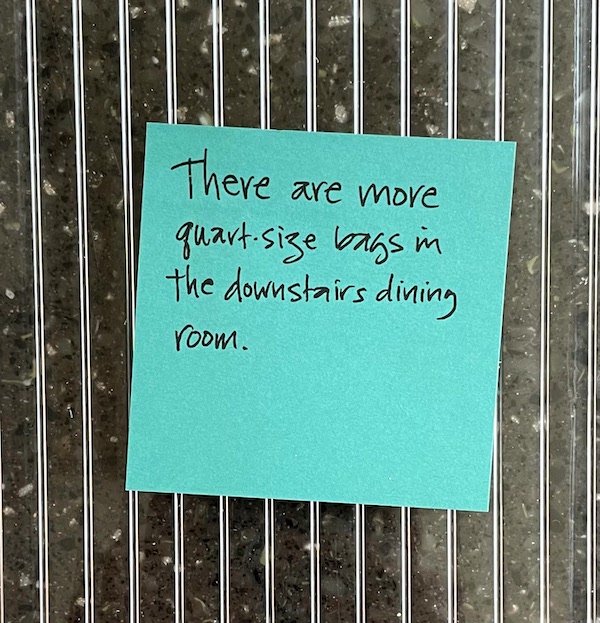
I had no recollection of having had extra quart-size bags, or of writing that note. It makes sense, though, since I’d bought a box that was too large for the drawer. I was so happy to see it!
It’s not the first time I’ve made these discoveries. I’ve been known to put notes near the bottom of a stack of coffee filters, for example, telling me where more coffee filters are stored, because otherwise I would have just ordered more when we were getting close to the bottom of the stack.
My memory isn’t what is used to be and I’m grateful to my past self for making my life a little easier! It’s just a little bit of effort and it’s so helpful.
Saying goodbye to Getting to Good Enough

We published the last episode of our weekly podcast Getting to Good Enough today. On June 15, 2018, my cohost Shannon Wilkinson and I published the first three episodes of Getting to Good Enough, a podcast about letting go of perfectionism so you can do more of what you love. I can’t believe it’s been five years! We were gratified by the enthusiastic response we received—we reached 50,000 downloads in the first ten months—and vowed to keep going as long as we were having fun.
We had lots of fun, but after we returned from a hiatus this summer, we realized that recording, editing and publishing the podcast was feeling like a chore. So we decided the time was right to say goodbye.
We plan to keep the episodes available for anyone to listen to indefinitely, so if you’re just hearing about the podcast now, you can go ahead and listen. Just look for it wherever you listen to podcasts. (Or, if you want, you can listen to it right on the website, linked above.)
Shannon and I are both so grateful for our audience’s support. Saying goodbye is definitely bittersweet, but we’re very grateful for the life-changing experience of doing the podcast.
ETA: In 2025, we decided to bring back the podcast! New episodes starting airing in September 2025.
The power of working with a professional organizer
I’m always amazed at how often I put off dealing with clutter in my own home. If I give it some focused attention, I’m able to declutter and organize pretty easily. But if I add a professional organizer to the mix and the process is supercharged!
Last week, I asked one of my employees, Lydia, to help me declutter and organize four spaces: one of my bathroom closets, my food-storage containers and two of my pantry cupboards. I am so glad I did.
My house is 115 years old and most of his not been renovated. If you are a lover of old houses, you’d probably really like my house. It has plenty of “character.” The bathroom closets are functional but not at all customized for storage. I reorganized my primary bathroom closet a few years ago (again) and I just let disorder creep in to the point where I could barely stand it any more. So I reached out for help. And I’m so glad I did.
In two hours, that closet went from this:
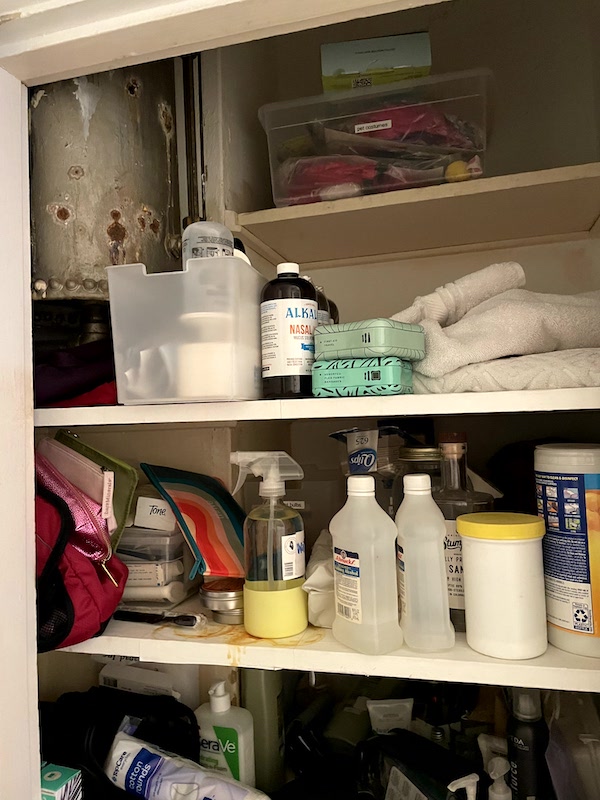
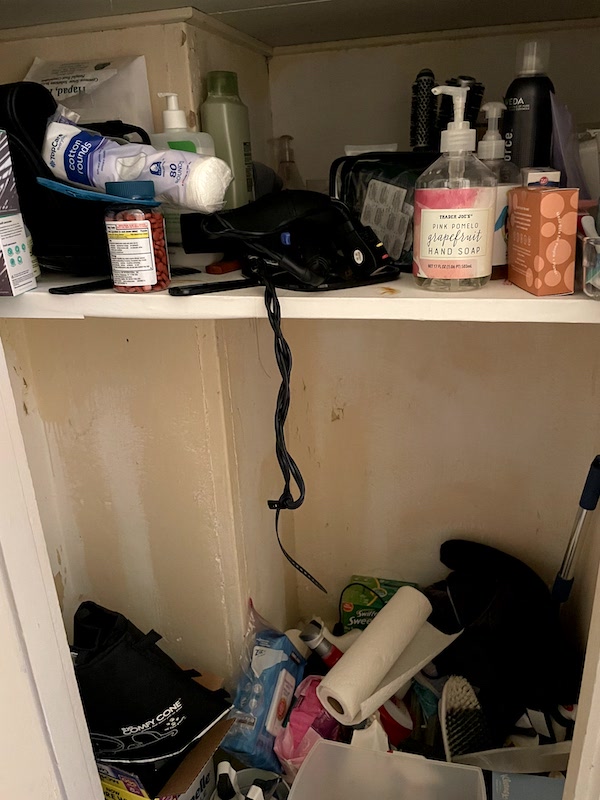
To this:
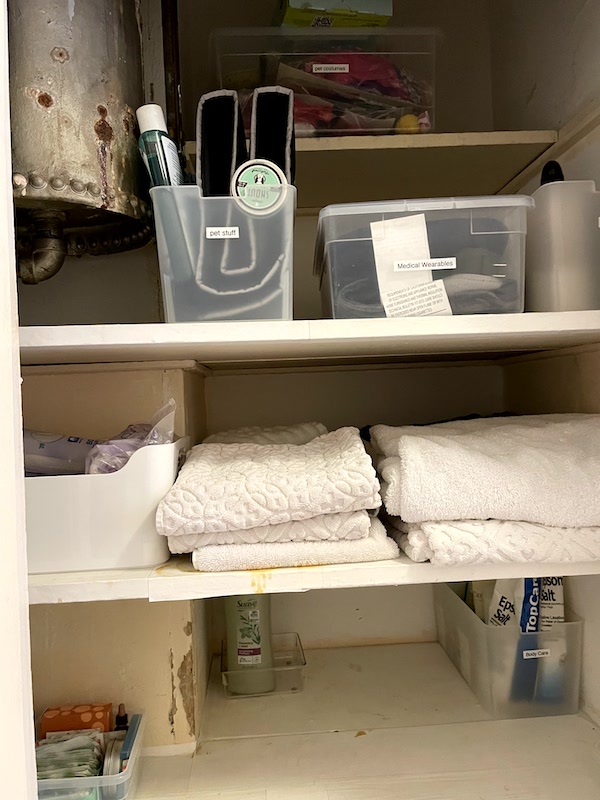
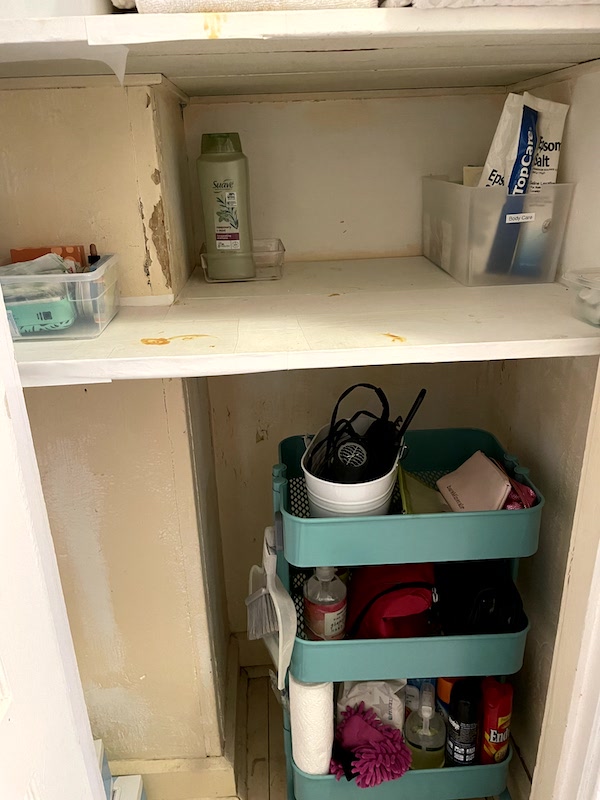
We emptied the contents of the closet, shelf by shelf, onto a folding table right outside the bathroom. I looked at each item, got rid of those that had aged out, sorted like things together and then put it all back together again. Lydia suggested that a three-tiered rolling cart would work well on the floor of the closet (genius!), so I repurposed the one I’d been using next to my washing machine. (In its place, I put a nightstand I’m no longer using, which stores my laundry supplies very nicely.) The cart is perfect for my purposes in the bathroom.
Moving items to the rolling cart not only made much better use of the floor space, it created space on the shelves. (That was helped a lot by my letting go of so much.) Lydia suggested we move the towels from the top shelf down a shelf (since we now had room) where they’re now within reach. We folded guest sets together and put them in the back of the shelf and the towels I use in the front. For 22 years, I have been storing towels on the top shelf, where it’s difficult for me to put them away and get them out. I struggled for 22 years. Why didn’t I consider moving them to a more accessible shelf?
I love it when I have organizers help me because it makes me really appreciate the value of working with an organizing professional. You set aside time to focus on the process. You make a financial commitment. And you get a fresh set of (expert) eyes on your situation. The five hours I spent with Lydia on Friday made a huge difference. I’m been smiling every time I use the refreshed spaces.
If you have spaces in your home that are getting on your nerves, I urge you to set aside some time to focus on decluttering and organizing them. If you have inclination and budget, you can supercharge the effort by hiring a professional to help! If you’re in St. Louis, shoot me an email. Or go to NAPO’s website to find an organizing professional near you!
Do you have a motto?
I have a personal motto that serves me well. I’ve talked about it here before (many times). Here it is:
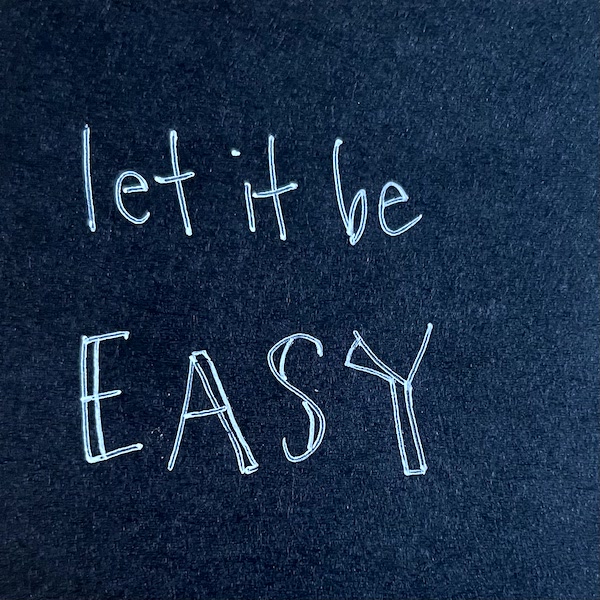
Another helpful motto I have is “it’s good enough.” I have to remind myself of that all the time. Case in point: I was going to re-write my motto for this post because the lettering wasn’t amazing. But I reminded myself that good enough is good enough. And I let it be easy and stuck with my imperfect sticky note. (If the idea of letting go of perfectionism interests you, check out the podcast, Getting to Good Enough that I co-host with Shannon Wilkinson.)
What’s your motto? If you don’t have one, maybe today is a good day to come up with one!
Worth repeating: Why I love American Ninja Warrior

Five years ago, I raved about my favorite summer TV show, the reality competition show American Ninja Warrior. I stumbled upon that post today and decided to re-run it because I still love this show for all the same reasons. I mentioned in the post that I watched it with my dad. He died 11 months ago, so watching it this year is bittersweet. A few little things have changed in the last five years, most importantly that I now have to watch it on Peacock, rather than Hulu. But it remains my favorite summer show.
My favorite summer TV series is NBC’s American Ninja Warrior. It’s the only show I watch live, because I can’t stand to wait until the next day to watch online. I watch it with my 87-year-old father when I’m visiting him and when I’m not there, we talk about it the next day over the phone.
In case you’re not familiar with it, American Ninja Warrior is a competition show, in which men and women race against the clock on ridiculously difficult obstacle courses. There are qualifying contests in a variety of cities. The top competitors in each city qualifier advance to the city final. The top competitors of the city final advance to the national competition in Las Vegas, which has up to four stages. The competitor who makes it fastest through the fourth stage wins a million dollars. So far, in nine seasons (the current season is the tenth), only two competitors made it to Stage Four (they were both in the same year), so only one has won the grand prize. This is crazy difficult.
People are sometimes surprised when I talk enthusiastically about the show. After all, it’s not exactly the epitome of sophistication. It’s noisy and has lots of flashing lights and yelling people and loud commentators. But it is so enjoyable and inspirational.
Here are some of the reasons I love it:
- Men and women compete on an equal playing field. That’s right, all competitors run the exact same course. The only advantage women are given is that the top five will advance to the city finals, even if they’re not in the top 30, and the top two will advance from the city finals to Las Vegas, even if they’re not in the top 15. That’s it. These women are unbelievable. Watch Allyssa Beird (a fifth-grade teacher!) finish Stage One in national final in Las Vegas last year:
- Old and young compete on the same course. This year they dropped the minimum age to 19 (from 21). There is no maximum age. One of my favorite competitors is Jon Stewart, who is my age. This year, at the age of 56, he finished the Dallas qualifiers, breaking his own record as the oldest person to finish a city qualifier. How can you not shout, “Go, Jon!” while you’re watching?
And here’s the youngest woman ever to hit to hit a buzzer, 20-year-old Casey Rothschild, a college student, at the Philadelphia qualifier, also this year.
- The competitors all support one another. It’s really wonderful to watch the competitors don each others’ fan t-shirts and cheer each other on. Great sportsmanship is always on display. In the video above, you can see Allyssa’s fellow women Ninjas going crazy for her. One of her closest competitors, who had failed that course, is shown crying with joy.
- They have such good attitudes when they fail. They almost always smile after falling and usually the comment is, “That was so much fun!” Even when the Ninja superstars (who are always expected to finish) fail, they just shrug and say some form of, “It happens to the best of us.” Witness superstar Drew Dreschel’s reaction after his embarrassing fall on the second obstacle in the 2014 Miami final.
- They showcase amazing come-back stories. Recently, there was an amputee who competed with prosthetic legs. There was a previous competitor who, between seasons, had been electrocuted and nearly died. There are always cancer survivors and people who have overcome all sorts of adversity. Again, inspirational.
Watching American Ninja Warrior is a wholesome, positive experience. It’s enthralling, inspirational, and a highlight of my summer each year. While ANW is a summer phenomenon, there are specials and variations you can see at other time of the year, I also love American Ninja Warrior: Ninja vs Ninja on the USA Network, which has teams of three ninjas, competing head to head, tournament style. Those courses are shorter because they’re all about speed. There is always at least one woman on a three-person team. So fun. There are also all-star competitions, international team competition, and even a celebrity edition (for Red Nose Day).
You can watch American Ninja Warrior live on NBC on Monday nights at 8/7 central or on the NBC website and on Hulu Peacock. (You can also watch the inspiring kids’ version, American Ninja Warrior Junior on Peacock TV.) You can see clips on You Tube. You can watch seasons on Amazon Prime at no additional charge or purchase the last two seasons on Amazon video.
Australia packing update
Before I left on my trip to Australia, I blogged about how I was able to pack everything in just a carry-on. I’m back from my trip and thought I’d give you an update on how that worked out.
As always seems to be the case, I brought more clothes than I wore. I had brought three dresses, as well as a cardigan, joggers, leggings and a sweatshirt. I didn’t wear one of the dresses at all and another dress I wore one evening only (and could have easily done without it). What ended up happening was that while I was packing my St. Louis summer self had difficulty envisioning what my Australia winter self would feel like. It felt colder than the temperatures led me to believe it would and I forgot that my family doesn’t really use heat inside the house. So I was cold most of the time. And that meant I wore the joggers, sweatshirt, a heavy cardigan, leggings and the heavier dress (along with a wool/cashmere shawl and a wool scarf) the whole trip. Sometimes I wore all those pieces at the same time!
See for yourself:
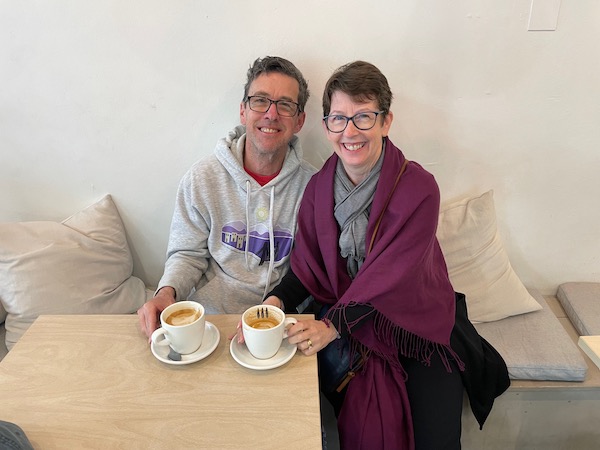
Here I am with my brother, Larry, wearing pretty much all the clothes I brought.
In hindsight, there are some things I would do differently. I had brought only a short-sleeved wool t-shirt and I wish I’d brought a long-sleeved one. And a turtleneck would have been smart too. I had brought knee-high boots to wear at the outdoor wedding party and they took up so much space that I wish I’d brought short booties instead. (That said, they helped keep my legs warm.) And I brought more jewelry than I wore.
I wish I had packed an electrical converter and my hairdryer because I didn’t have access to one while I was with family. (My family members don’t use hair dryers!) That meant I completely let go of the idea that my hair might look good, which actually brought lots of freedom. I embraced being a middle-aged woman in comfy clothes and no makeup.
I will say that traveling in merino wool Aspen joggers and Aspen crewneck sweatshirt from wool& was a great choice. I was comfy cozy on the 14-hour flights over the Pacific. I also took my doctor’s advice and wore Sockwell compression socks on the flights and they were quite comfortable.
My next trip I want to minimize what I pack AND wear everything I bring. I’ll consider if a personal achievement if I accomplish that!
Traveling to Australia with just a carry on
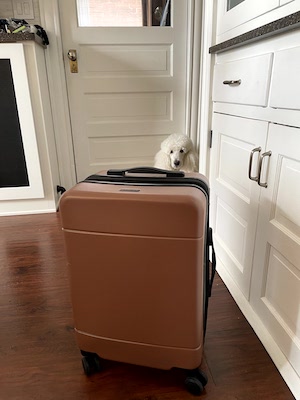
I’m on my way to Australia to visit family and participate in my niece and her new husband’s wedding celebration. Lucky me! I’ll be gone ten days, though of two of them will be spent in the air. I’m going to Brisbane and the Sunshine Coast, which are temperate, even in the winter.
I’m traveling alone (my husband was not up for such a long airplane ride) and wanted to make sure I could navigate the trip as easily as possible, so I worked hard to pack light. The last time I bought a suitcase was about 2011, so I treated myself to a new, lighter carry-on roller bag with spinny wheels that roll smoothly. (I bought this Calpack Hue suitcase at The Container Store!) I also bought some Calpack compression packing cubes so I was able fit all my clothes (including pajamas and robe) into the two cubes on one side of the suitcase. My shoes and toiletries went on the other side. (The suitcase has two equal-sized compartments.)
I wear merino wool 365 days a year, which is great for travel. Every garment I packed was merino wool, which is lightweight, warm, breathable and odor resistant. For the long flights, I’m wearing wool joggers and t-shirt and sweatshirt and I packed three dresses, a cardigan, leggings, boots and a couple of scarves. (I packed a non-wool sun hat too.) This is probably actually more than I need, but it will give me a little variety.
I started by making a list of what I wanted to bring and then I started crossing off those things that weren’t absolutely necessary. After I started packing, I realized I needed to cut back more. Using the carry-on suitcase as my space limit made it easy to edit down what I took.
I’m writing this in Los Angeles, where I arrived last night. I’ll be leaving for Australia close to midnight tonight. I’ll report back on whether I wore everything I brought or if there were things I’d edited from my suitcase that I wish I had packed. I’m excited that I was able to get everything into a carry-on!
Search
Recent Posts
- Worth repeating (once again): Decluttering old papers and memories
- Leaving my comfort zone
- Worth repeating (again): Lessons learned from a painful thumb
- Our 300th episode!
- Worth repeating: Figuring out what to watch on TV
- The power of incremental progress
- Podcast guest spot on the role of organization for folks with chronic illness
Tags
About Janine

Hello! I’m Janine Adams — a certified professional organizer based in St. Louis, and the creator of Peace of Mind Organizing®.
I love order, harmony + beauty, but I believe that the way that you feel about yourself and your home is what truly matters.
If you’re ready to declutter with a purpose and add more ease to your life, you’ve found the right blog — and you’ve found the right company.
read more »Links
- Institute for Challenging Disorganization
- Are you interested in becoming a professional organizer?
- National Association of Productivity and Organizing Professionals
- Getting to Good Enough podcast
- Peace of Mind Spending
- Shannon Wilkinson, life coach
- Organize Your Family History
- Ravelry
- NAPO St. Louis